
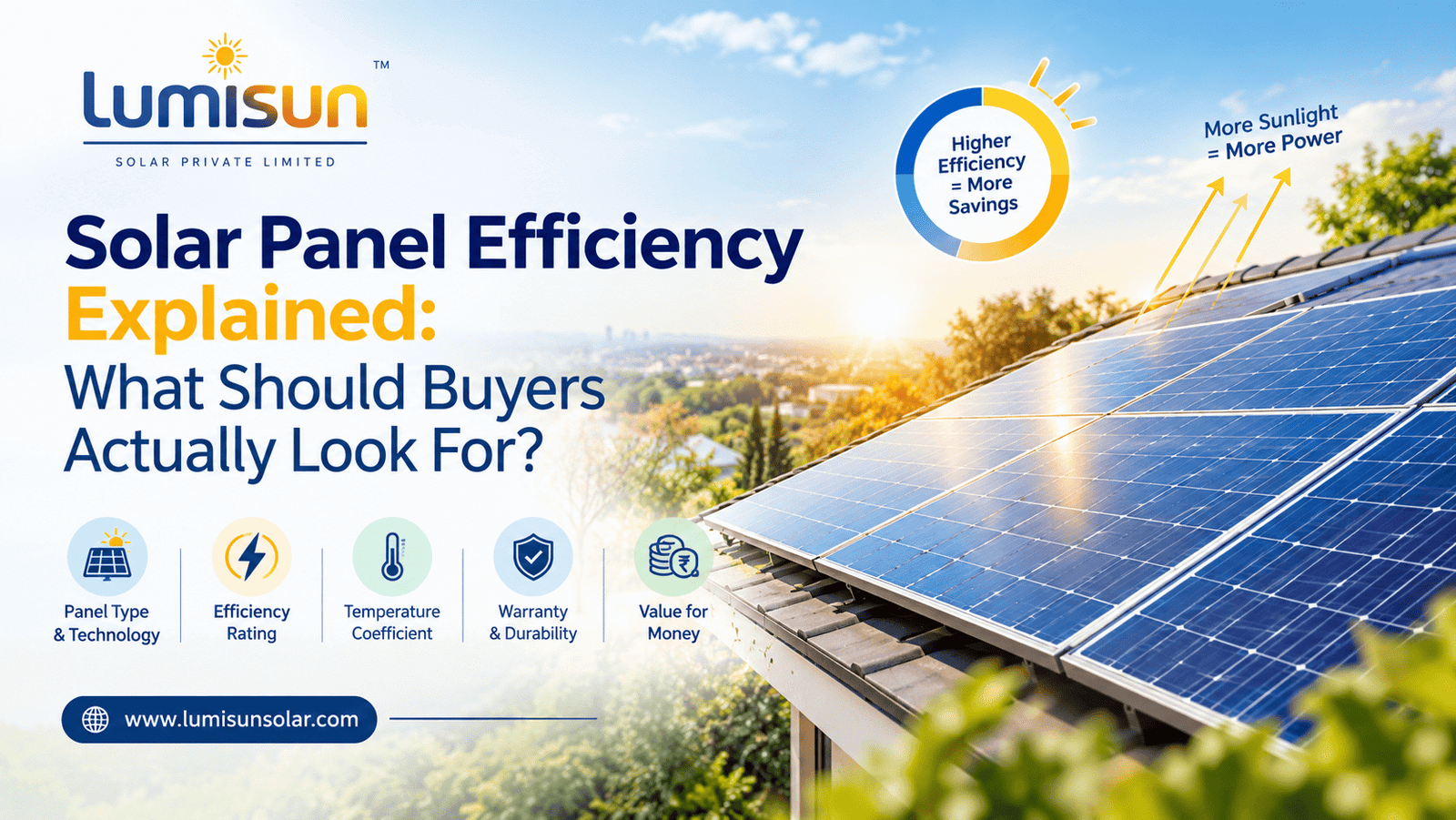
Everyone considering a solar panel will consider its efficiency before anything else. If there is one panel rated at 22% and another rated at 20%, it is easy to conclude that the former is better. But only that difference doesn’t tell you the full story. You also have to consider how the panel will perform on your roof, in your local climate and over many years.
If you are someone comparing solar panels in Hyderabad, understanding the efficiency can help you in avoiding paying more for something that will not perform as well as you expected.
What Does Solar Panel Efficiency Actually Mean?
Panel efficiency means the amount of light energy received by the panel in relation to the electrical energy produced.
So, when the solar panel efficiency is said to be 20%, it simply means that about 20% of the light energy received is converted to electrical energy under test conditions where the cell temperature is 25° C and solar irradiance of 1000 W/m².
When the area on the roof is limited, higher efficiency would be a better choice since it would mean a reduction in roof area needed to generate electricity from the same panels.
So, What Should Buyers Actually Check?
Efficiency is only the starting point
One of the most common mistakes people make is choosing a panel just because it has a higher efficiency. Efficiency is important when there is only a little bit of roof space available but temperature, shading and long-term performance is also just as important.
When you are comparing different kinds of solar panels, you should see the complete panel specifications rather than just the efficiency number.
Check how the panel handles heat
The testing of solar panels takes place at 25°C, however, the operating temperature may go beyond that when the panels are subjected to direct sunlight. Higher the temperature of the panel, lower will be the electricity generated. The temperature coefficient mentioned on the data sheet will give an idea regarding the effect of the change in temperature of the panel on its output.
This is particularly relevant for buyers considering rooftop solar in Hyderabad and Andhra Pradesh, where hot conditions can affect daytime generation.
Look at Long-Term Performance
Solar panels are a long-term purchase, so today’s efficiency percentage should not be your only concern. Look at the product warranty and the performance guarantee as well.
For example, Mono PERC panels can give a 12 year limited product warranty and 25 year linear power guarantee, while TOPCon dual-glass bifacial modules offer a 12-year product warranty and a 30-year linear power warranty. When a product has a stronger warranty, it gives buyers a better idea on how the panels will perform over time.
Don’t ignore the roof itself
Even if a solar panel is highly efficient, it will not perform well if the system setup on the roof is not set up properly. The direction of the panel, available space on roof, shadows from the neighbouring buildings or trees, panel placement should all also be taken into consideration.
This is why a proper site assessment matters. Instead of simply asking which panel has the highest efficiency, ask how much electricity the complete system is expected to generate each year.
Efficiency vs real-world generation
The number printed on a panel is measured under controlled conditions. Your roof is not a laboratory. Heat, dust, shade, wiring and other system losses can reduce actual output. Government rooftop-solar training material also notes that higher cell temperatures, dirt and wiring losses affect real-world performance. Beyond efficiency, buyers should also look at factors such as MNRE approval, warranty coverage, subsidy eligibility, installation quality and after-sales support, as these can all influence the overall value and long-term performance of a solar system.
That makes annual expected generation a much more useful question when comparing quotations. A leading solar EPC company should be able to explain how the proposed system is designed for your particular roof instead of focusing only on the panel’s headline efficiency.
What Should Buyers Ask Before Signing?
Before choosing a solar system, ask:
- What is the panel’s efficiency and power rating?
- What is its temperature coefficient?
- What are the product and performance warranty terms?
- How much electricity is the complete system expected to generate annually?
- Will shading or roof orientation affect generation?
- Are the panels and other components suitable for the proposed system and applicable government requirements?
A quotation from the best solar company in Hyderabad should make these details easy to understand rather than leaving you to compare complicated datasheets on your own.
FAQs
A. Not necessarily. Higher efficiency is especially useful when roof space is limited. If you have enough usable roof area, warranty, temperature performance, system design and overall cost also need to be considered.
A. Dust and dirt can block sunlight from reaching the cells, reducing generation. The exact cleaning frequency depends on local conditions, so the system should be checked regularly and cleaned when visible dust begins affecting performance.
A. No. The panel is only one part of a rooftop solar system. System sizing, roof assessment, installation quality, other components, monitoring and after-sales support also influence long-term performance.
Conclusion
Solar panel efficiency is important, but it should be treated as one part of the buying decision, not the entire decision. For homeowners comparing solar panels in Hyderabad, factors such as heat performance, warranties, roof conditions, system design and expected annual generation provide a much clearer picture of what they are actually buying.
With residential, commercial and other solar solutions, Lumisun Solar helps customers evaluate their requirements and plan the right system. If you are considering solar in Telangana or Andhra Pradesh, contact Lumisun Solar for a free site survey and personalised quote.
Follow us on Instagram.